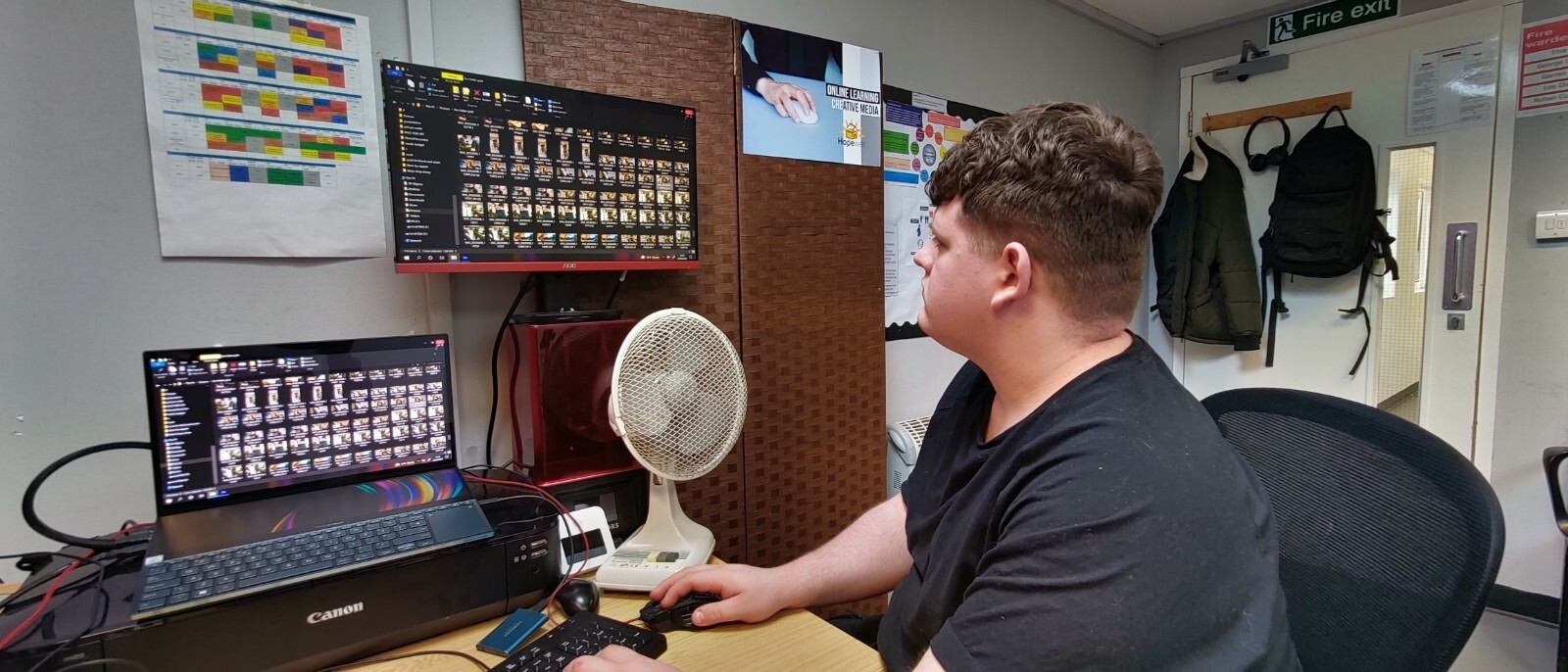
In this blog we hear from Head of Creative Media and Creative Technologies at Hopewell School, Adeshegun Ikoli, who uses creative media as ‘the engine of learning’ to connect other subjects with the arts and underpin young people’s Arts Award projects. Read on to discover how technology such as VR can help break down barriers, especially for young people with SEMH needs…
Creative media as the engine of learning
At Hopewell School, Creative Media is not a standalone subject, it is the engine that drives learning across the curriculum. Through a carefully structured Creative Media programme underpinned by Arts Award, students move through highly personalised learning journeys that connect English, Maths, Science, Geography, History and the Arts in ways that are meaningful, motivating, and accessible.
This approach runs seamlessly from Primary provision through to Post-16, ensuring continuity, progression and depth, while adapting to the individual strengths, needs and interests of every learner.
Personalisation first: Planning that starts with the student
Every Creative Media lesson begins with one key question:
How does this student learn best and how can technology unlock that?
Rather than delivering one project to an entire class, each learner follows a bespoke pathway shaped by:
- their interests (games, music, vehicles, storytelling, design)
- their communication profile (verbal, visual, kinaesthetic, assistive tech)
- their Arts Award level and evidence needs
- cross-curricular targets drawn from Maths, English, Science, Geography and History
The Arts Award framework allows this to happen without restricting creativity. Instead, it provides a structure where reflection, exploration, planning and evaluation sit naturally alongside practical making.
Learning beyond the classroom: Immersion through technology
Creative technologies are not “add-ons”; at Hopewell school they are core learning tools. Some examples of how creative technologies interact and enhance understanding in other subjects are:
Geography & Science in VR
Using Meta Quest VR, students don’t just learn about environments they step inside them.
- Exploring landscapes in 360°
- Understanding scale, distance and perspective
- Investigating environmental change through immersive scenes.
Students plan narratives, analyse environments, and explain processes verbally or visually embedding scientific vocabulary and geographical understanding in a lived experience.
Maths through flight & driving simulators
Flight and driving simulators transform abstract Maths into something concrete:
- plotting routes using coordinates
- calculating speed, distance and time
- adjusting variables and predicting outcomes.
For many students, this is the first time Maths makes sense, because they can see and feel the numbers in action.
Literacy without barriers: Film, podcasting & autocues
Creative Media also removes traditional barriers to literacy.
In the film and podcast stations, students develop:
- scripting and story structure
- sequencing and exposition
- subject-specific vocabulary
- spoken language confidence.
Autocue systems allow learners to:
- rehearse and refine language
- access complex vocabulary
- build confidence without the pressure of memorisation.
Podcast planning supports:
- persuasive writing
- explanation and reflection
- structured speaking and listening.
For students who struggle with written output, voice becomes the bridge to literacy, fully recognised and validated through Arts Award evidence.
History, arts & identity through storytelling
Students regularly embed historical research and artistic influences into their projects, for example in Discover and Explore Part B:
- researching practitioners
- exploring cultural contexts
- linking personal identity to creative outcomes.
Whether producing a short film, VR experience, digital exhibition or music project, learners are encouraged to place their work within a wider historical and artistic narrative, strengthening critical thinking and reflection and fulfilling the Arts Award criteria.
Why Arts Award makes this possible
Arts Award provides:
- flexibility without losing rigour
- recognition of digital, immersive and emerging art forms
- space for reflection that values process as much as outcome.
Most importantly, it allows learning to be evidenced in ways that suit the learner, not the other way around.
This is why Creative Media works so powerfully as a cross-curricular hub, it connects everything.
From primary curiosity to post 16 confidence
Across the school, we see the same pattern:
- Primary learners build confidence through play, exploration and making
- Secondary students deepen skills, language and independence
- Post-16 learners lead projects, manage resources and articulate their journey with confidence.
Creative Media becomes the thread that holds their education together, personal, purposeful and future-focused.
Final thought
When Creative Media and Arts Award are used with intention, depth and trust in the learner, education stops being something done to students and becomes something they own.
This is not about technology for technology’s sake. It is about bringing learning to life, one personalised journey at a time.
Enjoyed reading about how Creative Media transforms learning at Hopewell School and interested in finding out more? Check out Ade’s other blog on ‘The power of creative technologies in Arts Award delivery’.





Comments & Replies